AI facial recognition got a Florida dad wrongfully arrested for a crime 300 miles from home
The suspect was clean-shaven. Robert Dillon had a full beard. Police arrested him anyway. Here’s his story and how to protect yourself.
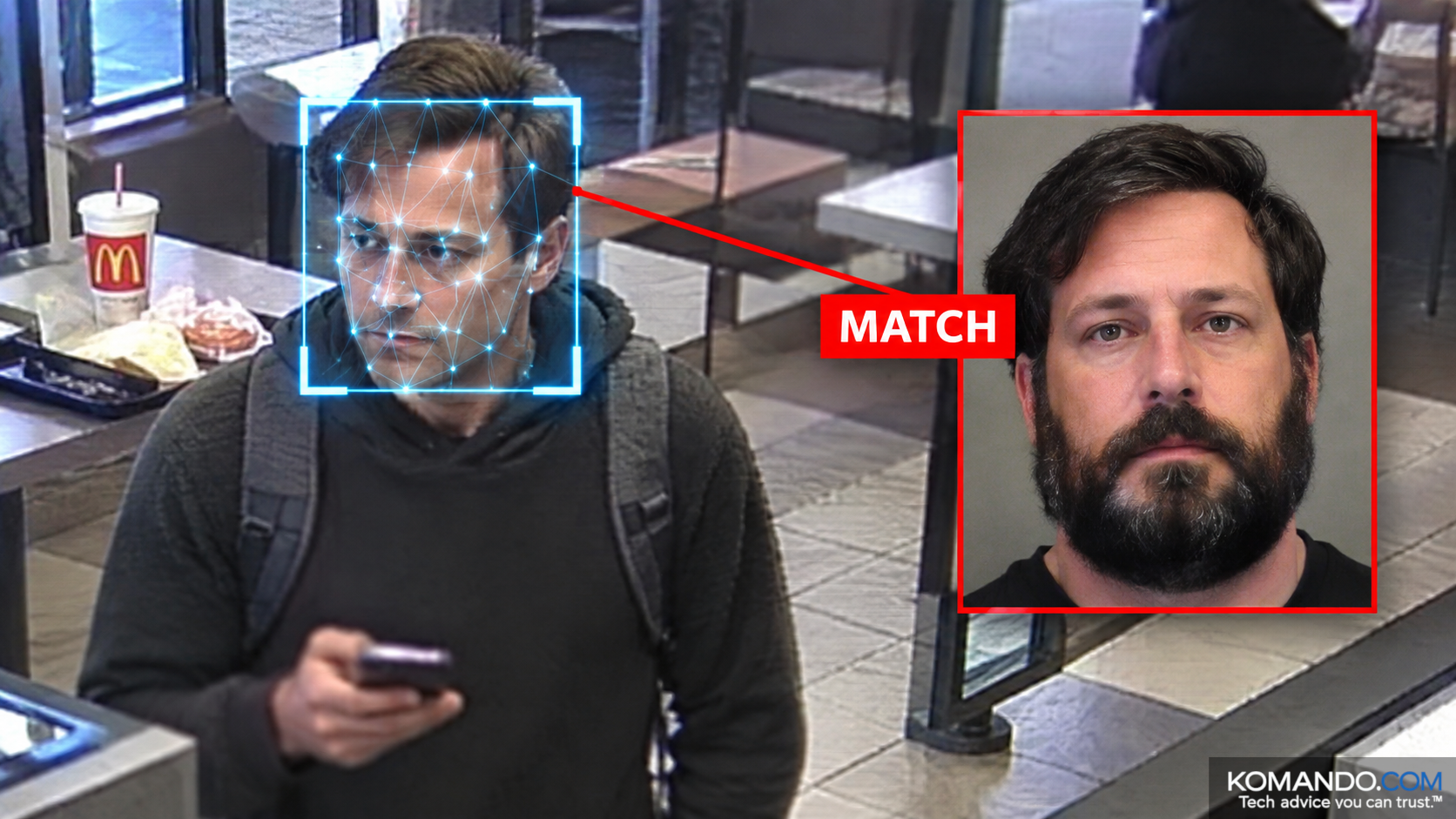
🤯 WOW! The man on surveillance video was clean-shaven. Robert Dillon had a full beard and mustache, and his wife had the photo to prove it. A computer said “match” anyway, and police put him in jail. He’s one of 15 known Americans wrongfully arrested this way.
📖 Read time: 2.75 minutes
 ChatGPT/Kim Komando
I need your help: Add Komando.com as a preferred source on Google
Robert Dillon is a 52-year-old crabber from Fort Myers, Fla. Husband. Dad. Regular guy. He told me on my show how a computer got him arrested.
In August 2024, police showed up at his door with a warrant out of Jacksonville Beach. The charge: trying to lure a child at a McDonald’s 300-plus miles away.
“I was absolutely stunned,” he told me. “I’ve never even been to Jacksonville Beach. Never been there in my life.” I’ve rarely heard a caller this rattled.
🔍 How a computer picked him
A sheriff’s office employee ran grainy surveillance photos through an AI-assisted facial recognition program. It flagged Robert as a possible match with 94% accuracy. A restaurant worker then picked his photo out of a lineup.
When these systems miss, they usually land on a look-alike. So the lineup turns into “pick the guy who looks like the guy.”
Red flags everywhere. The McDonald’s worker said the suspect was a regular. “I’m not driving five and a half hours every day to get a cheeseburger,” Robert told me.
The man on the video was clean-shaven. Robert’s wife had a photo of him from the day after the crime. “I had a full beard and mustache,” he said, “and you can’t grow that overnight, now can you?” (Unless you’re Tim Allen in The Santa Clause.)
Get this. A detective called Robert 10 months before the arrest. Robert, who has distinctive scars from a cancer surgery, begged him to look again. “I have scars that you cannot mistake,” he said. The detective said he was certain.
“If the police officers had done any kind of detective work,” Robert said, “they would’ve known right away.”
He spent four hours in a freezing holding cell in shorts and Crocs before county jail. Charges were dropped two months later. Afraid to leave the house, he lost his seafood business. “You can accuse me of anything in the world. I can take it on the chin,” he said. “But don’t ever accuse me of that.”
His mugshot is still online. The ACLU is suing on his behalf.
⚖️ This is bigger than one guy
More than 2,000 U.S. law enforcement agencies have access to facial recognition match technology, and no federal law sets accuracy standards.
Here’s what you need to know to protect yourself:
- Your phone is your alibi. Location history and time-stamped photos prove where you were. Don’t delete them.
- If police show up, stay calm and don’t resist. Ask for a lawyer before you say a word. Your lawyer can ask if facial recognition was used.
- Lock down your photos. Set social profiles to private. Companies scrape public pictures to build face databases police search.
A computer’s maybe should never be enough to cuff an innocent man. If you want to read more about this case, the details are here.
📩 Send this to someone who thinks, “I’ve got nothing to hide.”